Agentic AI for Marketers
1 AI Designer · 1 Service Designer · 3 organizations · 3 months
Human-AI Workflows · Agentic AI · Prototyping · Enterprise UX
An AI teammate that turns scattered signals into campaigns
Background
As part of Autodesk’s 14,000+ global workforce, all the elements we need to do our job are scattered across dozens of surfaces. We bounce back and forth between systems and surfaces, tools and agents trying stay on top of context, priorities, and deadlines.
The Enterprise Technology team set out to build a role-aware AI layer that sits above the various systems of record. Instead of sending people from app to app, the vision was that AI watches signals across those systems, brings forward what matters, and prepares the next step. Twenty-seven designers designed vision concepts in parallel for six role teams - sales, marketing, customer success and others.
Marketer’s Problem
Account-based marketers were stitching together 6sense, Salesforce, Marketo, Power BI, SharePoint and spreadsheets just to understand an account before acting. Signals are scattered across various dashboards and handoffs to Sales were one-way with no feedback. Our challenge was to let AI do that assembly work without taking the decision away from the marketer, or sending the wrong assets to the wrong account.
My Role
Lead Designer for the marketing experience
Ran discovery with marketing operations managers and three ABM marketers, then narrowed the focus to one-to-few marketers where the need was sharpest
Mapped 12 jobs-to-be-done and the end-to-end journey from planning to sales handoff
Ideated in Chat GPT and Claude, then prototyped flows Claude Code and put them in front of marketers early
Ran cross-team design reviews that aligned layout, AI entry points and interaction patterns
Co-created a designer guide with experience principles and five questions every team used to shape AI experiences
Solution
Decision board, not dashboard. The first view leads with "What needs my attention"
Context before action. Every AI-surfaced signal explains why now, with sources, so a marketer can inspect the reasoning or drill into the account before acting
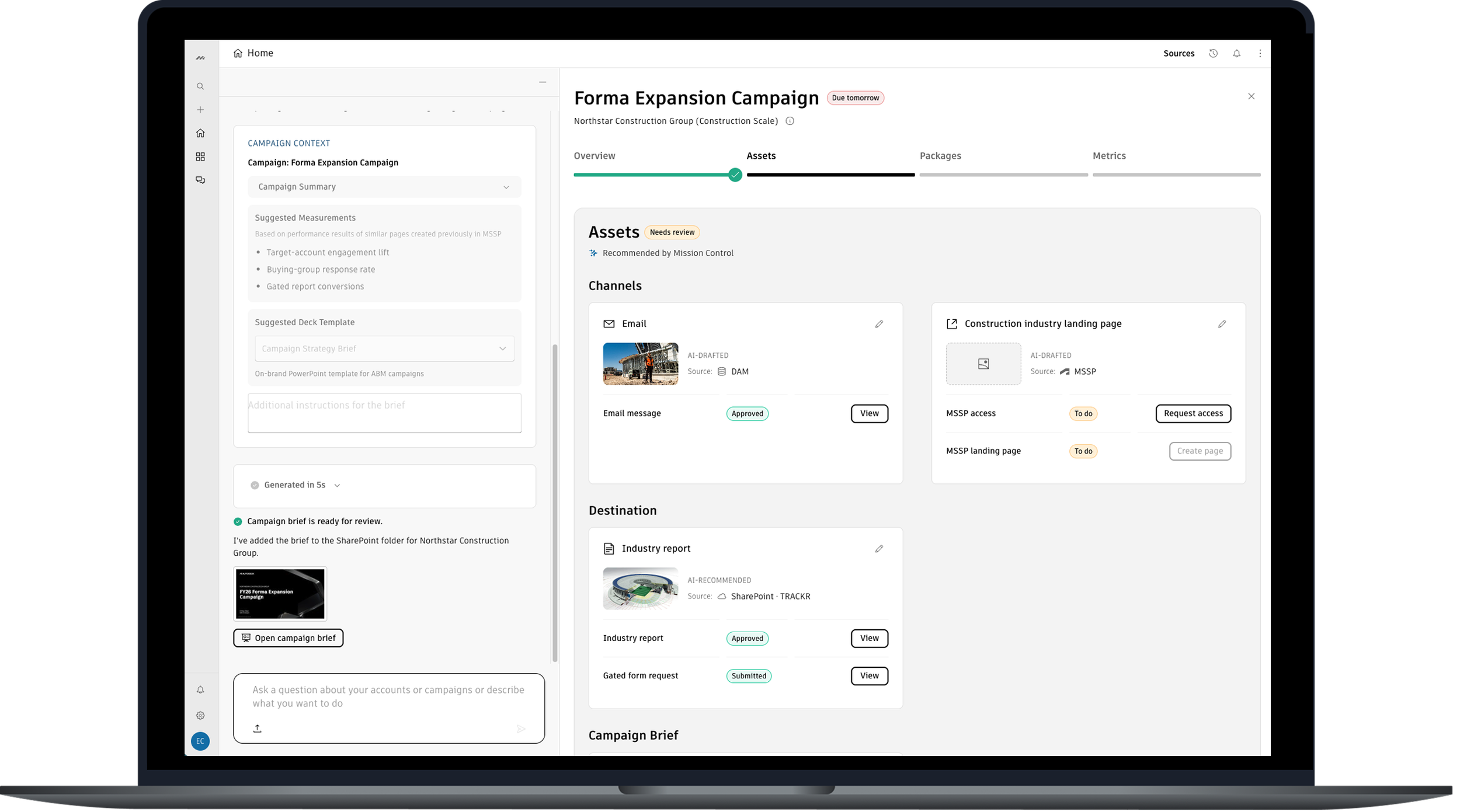
AI drafts labeled. The campaign package marks ready-to-use sourced assets apart from AI drafts that need review, with per-asset status (ready, needs revision, awaiting approval)
AI prepares, human decides. The AI pre-fills tool and form requests, but the marketer approves them. Low-risk clerical steps are automated; consequential ones like sending a package to Sales need confirmation
Targeted handoffs. Section-level share actions replaced one broad "share" button, and the sales package stays marketing-authored so the AI never appears to rewrite it in transit
Outcome
Delivered the "Connects" moment of the leadership demo: a signal, an AI-assembled campaign package, and a handoff to Sales
Extended the flow with AI deck generation for the follow-up demo
Prototype covered 6 of 13 marketer jobs and gave the team a clear map of what came next: cluster prioritization, account 360, marketer-initiated work
Research reshaped the product: recommendations reframed around customer outcomes, signals shown with context, and bulk actions that separate reusable from account-specific content
The designer guide and shared patterns kept six parallel teams cohesive
Any stakeholder reception, funding or roadmap decision (e.g. MVP scoped for the Feb 2027 Sales Kickoff)
Takeaway
The hardest design work wasn't what the AI could do. It was deciding what the marketer must see, check and approve before the AI acts on their behalf.